

When a new analyser arrives in a laboratory, everyone expects the same thing: the barcoded tube goes into the device and the result lands in the patient's record without anyone typing it in. Behind this is the integration between the device, the laboratory information system (LIS) and the hospital information system (HIS). In this article we wanted to explain how that integration works and where installations most often get stuck.
Which language do the devices speak?
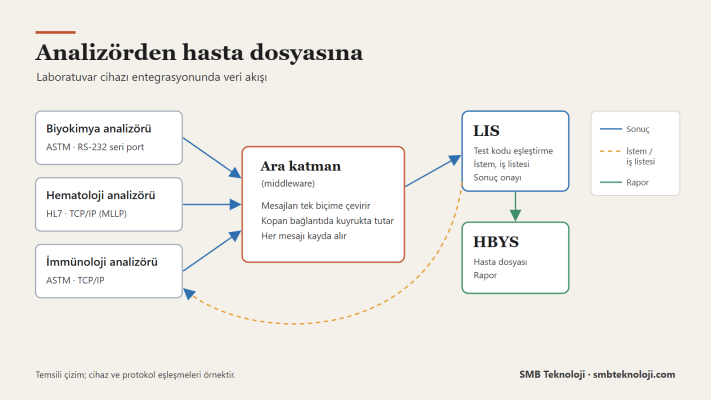
Most laboratory devices use one of two standards.
ASTM is an old but still very widespread protocol, maintained today by CLSI under the names LIS1-A and LIS2-A2. Messages consist of records such as header (H), patient (P), order (O), result (R) and terminator (L). During transmission the two sides handshake step by step using control characters such as ENQ, ACK and EOT.
HL7 v2 is more the language of hospital systems. Messages such as ORM^O01 or OML^O21 are used for orders and ORU^R01 for results. Patient data is carried in the PID segment, the order in OBR and each individual test result in an OBX segment. Messages are sent over TCP/IP using MLLP.
In the same laboratory, the chemistry analyser may speak ASTM and the haematology analyser HL7. The first task of the integration is to pin down which protocol each device uses, in which version and with which settings.
Cable or network?
Older and some smaller devices still use an RS-232 serial port. Baud rate, parity and stop bit settings must be identical on both sides. Most new devices connect over TCP/IP. A serial-to-Ethernet converter can be used to bring a serial device onto the network, but that also means one more connection point to monitor.
One-way or two-way?
In a one-way connection the device only sends the result; the technician enters on the device which tests are to be run on which tube. In a two-way connection, when the device reads the barcode it asks the LIS which tests have been ordered for that tube, or the worklist is sent to the device in advance. A two-way setup greatly reduces manual entry errors, but it requires the test codes to be mapped correctly on both sides.
Where do installations most often get stuck?
- Test code mapping: Is "GLU" on the device the same test as "Glucose (fasting)" in the LIS, with the same unit and number of decimal places?
- Rerun samples: Which of the rerun and dilution results goes into the report.
- Quality control samples: Making sure QC results don't land in the system like patient results.
- Turkish characters: Letters such as ğ, ş and İ in patient names getting garbled on the device screen or in the report.
- Clock and connection drops: The device clock being wrong; results that pile up while the network is down being transferred completely afterwards.
Most of these problems can be solved before installation day, using the test code list and sample messages.
What does middleware do?
If a laboratory has more than one device, a middleware layer can be used instead of connecting each one to the LIS separately. The middleware converts the different messages coming from the devices into a single format, queues results when the connection drops and logs which message went where and when. When a result goes missing, these logs are the first place to look.
Network and KVKK
Devices carry patient data. Keeping the device network in a separate VLAN from the rest of the hospital network, granting remote service access through a controlled, logged VPN, and planning the server and backup setup from the start are also important under KVKK (Türkiye's Personal Data Protection Law).
A short note for device distributors
If the device works on installation day but results don't flow into the hospital information system, the laboratory considers the installation unfinished. Collecting the test code list, the contact details of the LIS and hospital information system vendors and the device's interface documentation before installation significantly shortens the time spent on site.
At SMB Teknoloji we work on HL7 and ASTM integration of laboratory devices with LIS and hospital information systems, middleware and laboratory network infrastructure. If you need support with an installation or an existing integration, you can write to us: [email protected]